My Semester Project
The math behind a maze is quite complex. It uses principles from graph theory and Hamiltonian Paths,
but lets just put this into simple terms. When creating or solving a maze the goal is always to find
the correct path through. In other words, Mazes typically look very messy, so the first thing a mathematician
might want to do is tidy a maze up and abstract it out into a collection of nodes (or vertices) joined by paths
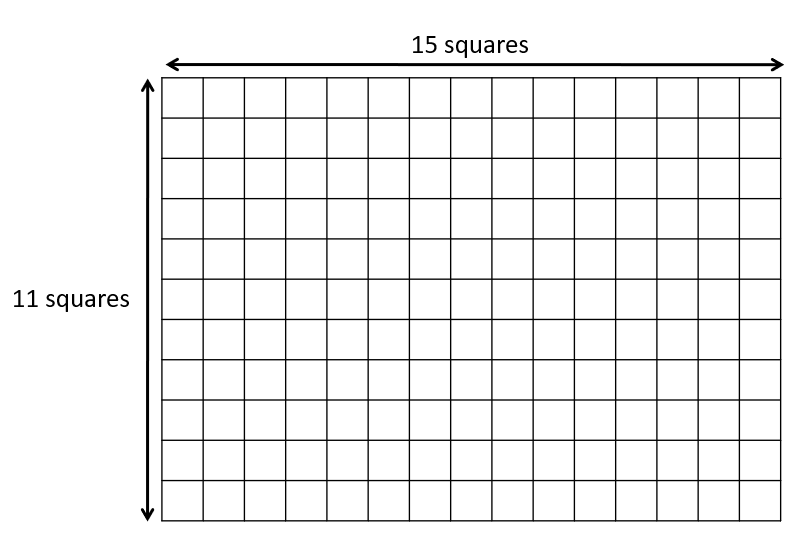
(or edges) (Williams, 2020). Lets start by looking at a rectangle of any odd dimension, for example we will
look at a 15x11 rectangle.
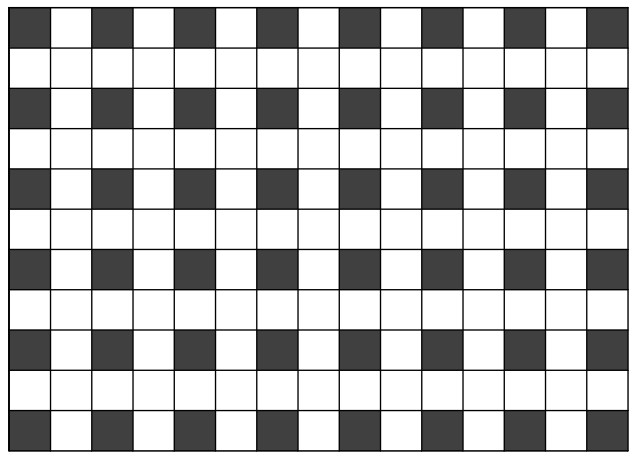
Then we will checkerboard the rectangle.
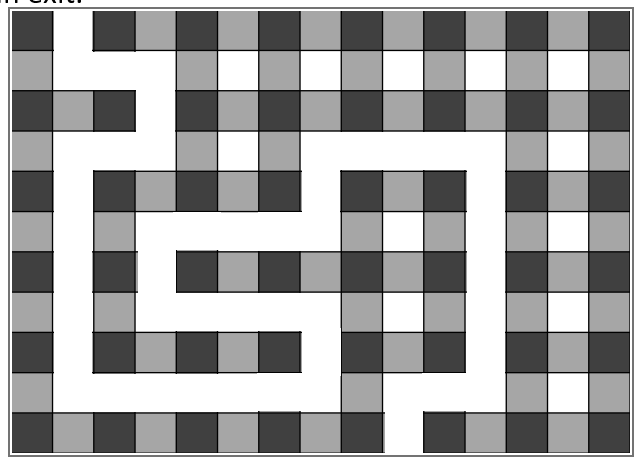
We will then create what is considered a hamiltonian path. Which just means that you can start at one starting
point and go all the way to the ending point. Something like this.
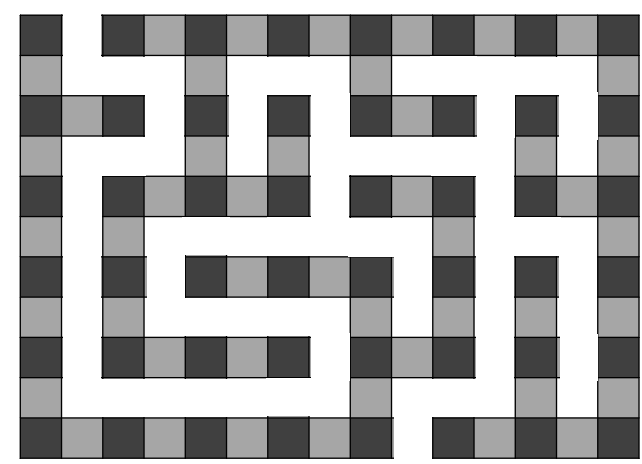
Once we have a path created we can create limbs off our path to confuse and trap by filling in the white boxes.
At this point our maze is finished. We know that it has only one way out because we have drawn our path is
the only way that leads from our start vertex to our end vertex.
Labyrinths use a more geometric form of creation. They rely heavily on the use of semi-circles and reflections.
Here is a quick walk through of how these beautiful traps are created. The first step when creating a labyrinth
would be to select the amount of semi-circles you want to base your labyrinth on. The more semi-circles you have
the larger your labyrinth is, for this example we will just look at 8 semi-circles and find a center point (in green).
Work through the GeoGebra below to see how this works.
Back To My Main Page
Top Of Page